


Purpose: The purpose of this Article is to define the scope of the project and the solution provided to the client.
This technical analysis delves into the solution developed by Technosoft Solutions Inc. for a client, enabling them to interface with Quest Diagnostics to process and transmit HL7 messages for lab orders and results. The solution leverages a C# class library built with NHapi, a .NET HL7 API, to facilitate seamless data exchange within a healthcare ecosystem. The primary objective was to enable a client to process incoming HL7 messages, store relevant data in an MSSQL database, and generate outgoing HL7 messages, including lab orders, lab results, and message-level acknowledgments.
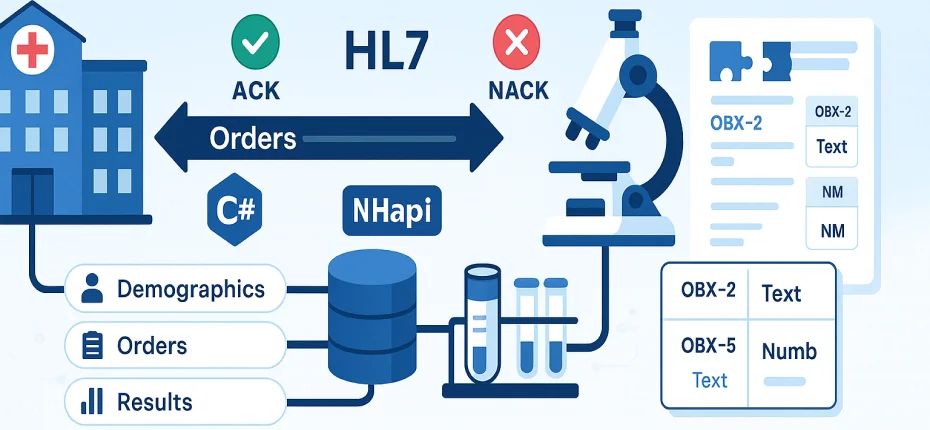
HL7 Messaging Standard and NHapi Framework
Requirement, Solution Architecture and Core Components
Requirement
Our client wanted to create a solution to interface with Quest Diagnostics to process received HL7 messages and save them in their MSSQL database, generate and transmit HL7 messages from their database. The database-related solution was to be provided using Microsoft’s Entity Framework. The solution was designed to support HL7’s lab order and lab result messages and generate message-level acknowledgments.
Solution Provided
After analyzing the client’s requirements, Technosoft provided a C# class library using NHapi for HL7 messages. The library exposed methods to parse and generate HL7 messages, as well as methods to generate acknowledgments.
Key Classes and Their Functionalities:
The following classes were designed to fulfill the client’s requirements:
- Message Generation: Methods to generate HL7 messages related to patient demographics, typically ADT (Admission, Discharge, Transfer) messages. For instance, the ConvertPatientDemographicsToHL7 method generates an ADT_A28 message against a Medical Record Number (MRN) and a receiving entity. This involves extracting data from the database, formatting message segments, adding MLLP (Minimum Lower Layer Protocol) wrappers, and converting the message to a string for transmission.
- Message Parsing: Methods to parse incoming HL7 messages containing demographic information. The ConvertHL7ADTToDemographics method parses an HL7 message string into a demographic message object, retrieves data from segments, and saves it to the database. It also returns status codes to indicate the success or failure of the message processing.
- Lab Order Message Creation: Methods to create HL7 lab order messages (e.g., ORM_O01) based on data retrieved from the database. The ConvertOrderToHL7 method takes a lab order ID and receiving facility ID as parameters. It fetches relevant data from the database, populates the ORC (Common Order) and OBR (Observation Request) segments of the HL7 message, adds MLLP wrappers, and converts the message to a string.
- Lab Result Message Processing: Methods to parse incoming HL7 lab result message strings (e.g., ORU_R01) and save the extracted data into the database. The ConvertHL7ResultToLabResult method parses an HL7 OBX (Observation/Result) inbound message, reads data from its segments, and stores it in the database. It also provides status codes for message processing.
- Panel Result Handling: A significant feature of this class is its ability to handle complex panel results. This involves scenarios where results for a panel may be received in multiple messages or results for multiple orders may be present in a single message. The system intelligently retrieves order information from the database and stores results corresponding to individual lab tests within a panel. It also accounts for the data type of result values (numeric or text string) based on the OBX-2 field, ensuring correct storage in the database.
- ACK Generation: The GenerateACK method generates an ACK message against the original message and message type provided as parameters.
- NACK Generation: The GenerateNACK method generates a Negative-ACK message against the original message provided as parameters.
This class provides internal utility functionalities for the library, such as setters and getters for specific HL7 message segments. It supports functions like GetPatient, SetInsuranceInfo, SetMessageHeader, SetOBR, SetORC, SetPatientVisit, SetPID, SetPractitioner, TimestampToDatetimeNotNull, and TimestampToDatetimeNullable.
HL7 Lookup Values and Tables
- HL7 Tables: These are values defined and published by HL7, affecting the interpretation of messages. They cannot be redefined locally but can be extended. An example is HL7 table 0003 – Event Type, where the ID data type is commonly used.
- User-defined Tables: These are locally or site-defined values that accommodate fields that vary between institutions (e.g., PV1-3 – Assigned patient location). While not defined in the standard, they are assigned user-defined table numbers for implementation. The IS data type is often used for values in these tables.
The Challenge: Navigating Complex Lab Workflows
- Manual Entry Errors: Transcribing lab orders and results manually is prone to human error, leading to incorrect tests, delayed diagnoses, and potential patient safety risks.
- Operational Inefficiencies: Paper-based workflows and lack of system integration create bottlenecks, consuming valuable staff time that could be better spent on patient-facing activities.
- Delayed Information Access: Slow retrieval of lab results can hinder timely clinical decision-making, impacting treatment plans and patient satisfaction.
- Interoperability Gaps: Different healthcare IT systems often struggle to communicate effectively, creating data silos and limiting a holistic view of patient health.
- Compliance Concerns: Managing sensitive patient data requires strict adherence to regulations like HIPAA, and manual processes can increase the risk of non-compliance.

Key Benefits for Healthcare Providers
- Enhanced Efficiency and Productivity
- Improved Data Accuracy and Patient Safety
- Seamless Interoperability and Connectivity
- Optimized Patient Management
- Automated Lab Ordering: Electronically send lab orders directly from your existing Electronic Health Record (EHR) or practice management system to Quest Diagnostics. Eliminate manual paperwork, reduce order entry time, and minimize errors.
- Real-time Results Delivery: Receive lab results directly back into your system as soon as they are available. No more waiting for faxes or manual data entry, enabling faster clinical review and patient communication.
- Streamlined Workflows: Automate the entire lab requisition and results reporting process, freeing up your staff to focus on higher-value tasks and improving overall operational efficiency.
- Reduced Manual Errors: By automating data exchange, the solution significantly minimizes the risk of transcription errors, ensuring that the right tests are ordered and the correct results are associated with the right patient.
- Consistent Data Flow: HL7 standardization ensures that data is exchanged in a uniform and structured format, maintaining data integrity across all integrated systems.
- Timely Clinical Decisions: Rapid access to accurate lab results empowers clinicians to make informed decisions quickly, leading to more effective treatment plans and improved patient outcomes.
- HL7 Compliance: Built on the widely adopted HL7 standard, our solution guarantees compatibility with a broad range of healthcare IT systems, facilitating seamless integration with your existing infrastructure.
- Bidirectional Data Exchange: Supports both sending lab orders to Quest Diagnostics and receiving results back, creating a complete and closed-loop communication cycle.
- Future-Proof Integration: The use of the NHapi framework provides a flexible and scalable foundation, allowing for easy adaptation to evolving HL7 standards and future integration needs.
- Comprehensive Patient View: Integrate lab data directly into patient records, providing a holistic and up-to-date view of each patient’s health status.
- Efficient Patient Demographics Management: Automatically update and manage patient demographic information, ensuring accurate patient identification and record keeping.
- Proactive Acknowledgments: Automated acknowledgment messages confirm successful order transmission and result receipt, providing peace of mind and reducing follow-up calls.
Beyond Quest Diagnostics Lab Integration: A Partnership for Better Healthcare
Enhance Patient Satisfaction
Faster results and more efficient processes lead to a better patient experience.
Improve Clinical Outcomes
Timely and accurate information supports better diagnostic and treatment decisions.
Achieve Operational Excellence
Optimize your workflows, reduce costs, streamline operations and maximize staff productivity.
Maintain Regulatory Compliance
Leverage a secure and standardized data exchange mechanism that supports HIPAA and other healthcare regulations.
Unlock the Full Potential of Your Lab Operations
The Quest Diagnostics Lab Orders & Results interface development using nHAPI demonstrates a robust and well-structured approach to HL7 integration in a healthcare setting. By leveraging the NHapi framework and a modular class library, the solution effectively addresses the complexities of processing patient demographics, lab orders, and lab results, while ensuring data integrity and interoperability. The emphasis on standardized messaging and flexible handling of lookup values positions this solution as a reliable component within a broader healthcare IT infrastructure.
In a healthcare environment where every second and every data point matter, our solution for Quest Diagnostics integration offers a clear competitive advantage. By automating and standardizing your lab orders and results workflows, you can unlock new levels of efficiency, accuracy, and patient care. Embrace the future of healthcare data exchange and empower your practice with seamless, intelligent integration.
Comments